


Table of Contents
- Low-Maintenance Decking Fundamentals for Nebraska Homeowners
- Composite vs. Cedar: The Truth About Low-Maintenance Materials
- Material Installation and Durability Deep Dive
- Effective Cleaning and Care for Composite Decks
- Advanced Maintenance Strategies and Long-Term Care
- Your Path to a Hassle-Free Outdoor Retreat
Low-Maintenance Decking Fundamentals for Nebraska Homeowners
When you picture the perfect Nebraska summer, you imagine relaxing on a beautiful deck, not spending your weekends sanding and staining. That’s where a low maintenance deck changes the equation. For homeowners across the state, low-maintenance decking means no annual staining or sealing, no worries about rot from spring rains or insect damage, and none of the warping or splintering that Nebraska’s freeze-thaw cycles and powerful thunderstorms can cause in traditional wood.
Composite decking offers the most reliable path to an upkeep-free deck. Unlike first-generation uncapped boards, today’s capped composite decking wraps a durable polymer shell around the core, blocking moisture and UV rays so the surface resists fading, stains, and scratches. For routine care, an annual composite deck cleaning with mild soap and water removes built-up pollen and debris—no sanders or chemical strippers needed. Instead of losing your weekends to maintenance, you can spend that time enjoying backyard barbecues and quiet evenings on a deck that looks freshly built year after year. We know folks in Omaha want more time for living and less for scrubbing. As a family-owned company specializing in TimberTech and other premium composites, we help neighbors across Nebraska create stunning outdoor living spaces that let you relax every weekend, not maintain them. Choosing a low maintenance deck is an investment in more free time and a stronger home value. And with our free onsite estimates, getting started is as easy as inviting us out to see your backyard.
Composite vs. Cedar: The Truth About Low-Maintenance Materials
When planning a low maintenance deck in Nebraska, homeowners often weigh composite decking against traditional cedar wood. Both offer distinct advantages, but understanding how each material behaves in our region’s climate is key to making the right choice.
The Core Difference: Organic vs. Engineered Materials
Cedar is a natural wood that breathes and shifts with humidity, lending it warm, authentic grain. In Nebraska’s climate, that organic nature demands yearly power washing to fight mildew, sanding to smooth weathered surfaces, and re-application of sealers to prevent splitting and warping. Composite decking, by contrast, is an engineered product made from recycled wood fibers and synthetic polymers that remains dimensionally stable and resists rot, insects, and moisture. Because it doesn’t absorb water, it never needs staining or sealing—just an occasional wash. In our work serving Omaha and surrounding areas, we’ve seen how this core difference frees homeowners from time-intensive upkeep while delivering lasting durability.
What is Composite Decking Made Of?
Composite decking blends recycled wood fibers with polyethylene or PVC, then caps the board with a protective polymer shell. This engineered composition blocks moisture and UV radiation, so the material won’t warp or host mold—critical advantages during Nebraska’s humid summers and freeze-thaw winters. Composite deck cleaning is as simple as hosing off dirt and using mild soap, with no sealing required.
Side-by-Side: Composite Decking vs. Wood
The table below compares the key factors Nebraska homeowners evaluate when deciding between composite decking and cedar wood.
| Factor | Composite Decking | Cedar Wood |
|---|---|---|
| Annual Maintenance | Wash with soap and water; never requires staining, sealing, or painting. | Requires annual power washing, sanding, and re-sealing or staining to prevent graying and decay. |
| Weather Resistance | Excellent resistance to moisture, freeze-thaw cycles, and UV fading with capped composites. | Naturally resists rot and insects but is prone to splitting, warping, and moisture absorption in snow. |
| Lifespan | 25–30+ years with minimal upkeep; many capped composites come with 25-year warranties. | 15–20 years with diligent annual maintenance; susceptible to structural fatigue from wet conditions. |
| Upfront Cost (Material Only) | $8–$12 per square foot for capped composite boards; higher initial investment. | $4–$7 per square foot for premium clear cedar; lower initial material cost. |
| Aesthetic Appeal | Wide range of wood-grain textures and fade-resistant colors; maintains appearance without treatment. | Natural rich grain and warm color; will silver and fade without constant maintenance, which some homeowners prefer. |
Composite decking’s weather resistance and zero-maintenance finish clearly suit our region’s harsh conditions, while cedar’s lower upfront cost and natural charm appeal to those willing to invest time in upkeep. The infographic below summarizes these trade-offs at a glance for Nebraska and Iowa properties.
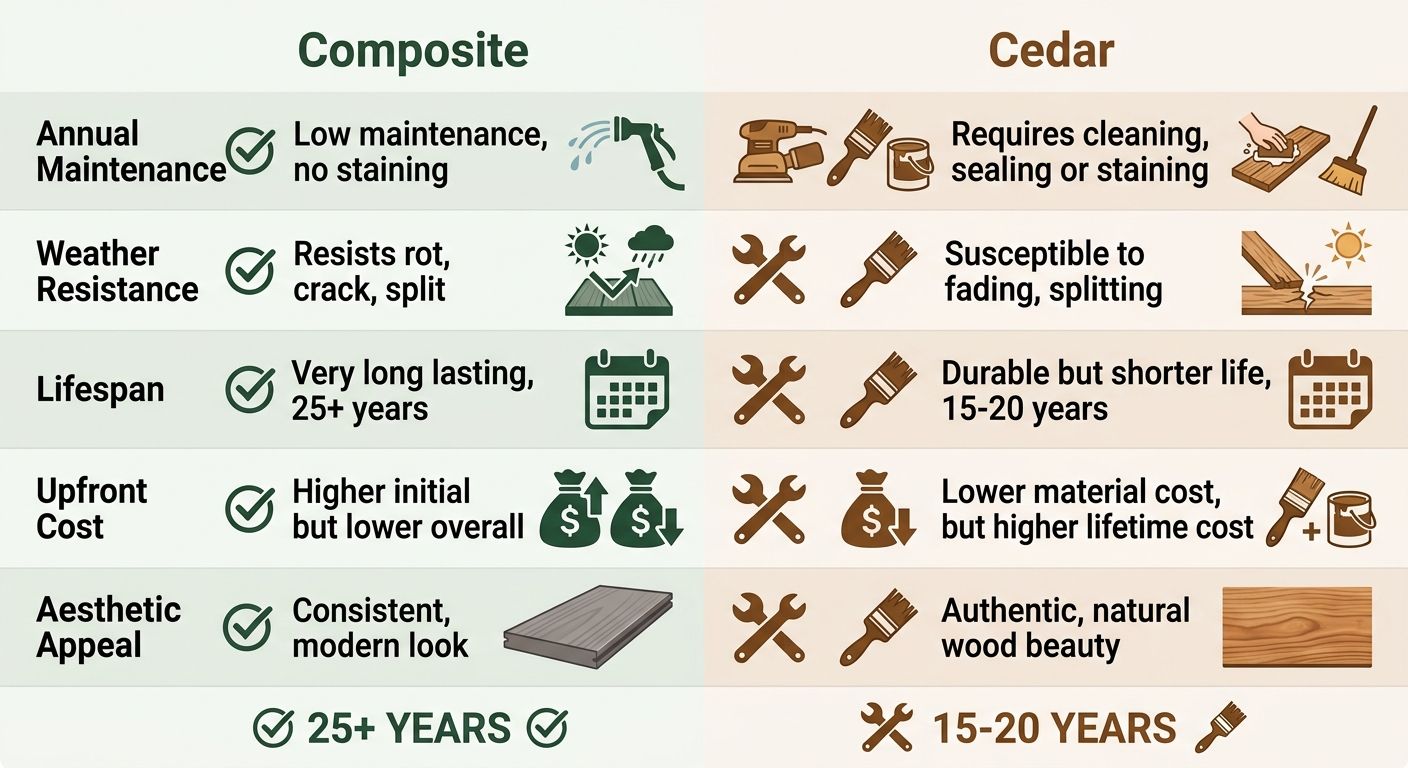
Composite and cedar decking comparison guide for homeowners in Nebraska and Iowa.
Is Composite Decking Really Worth the Cost?
Beyond the initial price tag, composite’s long-term value becomes clear when you add up annual cedar maintenance. In our experience, professional cleaning and resealing can cost hundreds each year, and over 15 years those expenses rival the higher upfront investment in composite. With a composite deck’s 25–30 year lifespan and manufacturer warranties often reaching 25 years, you avoid a second material purchase and enjoy decades of near-zero maintenance. Many homeowners further enhance their investment by adding deck lighting—an integrated feature that increases enjoyment without adding chores. Ultimately, composite pays for itself in both time and money.
Material Installation and Durability Deep Dive
How Long Does Composite Decking Last in the Midwest?
When homeowners across Nebraska search for a low maintenance deck, they’re really asking about lifespan and resilience. Our harsh freeze-thaw cycles demand materials that can handle moisture and temperature swings without constant attention. As custom deck builders serving all of Omaha and surrounding areas, we’ve found the answer in capped composite decking. These boards feature a proprietary synthetic shell that completely encapsulates a wood-plastic core, acting as an impermeable shield against moisture intrusion and the fading UV rays that cause splintering, mold, and color bleaching on traditional wood. Unlike uncapped composites that can absorb water through exposed fibers, a capped board repels liquid across all surfaces, preventing interior swelling and surface checking. According to our experience, a properly constructed capped composite deck can last 25 to 50 years, far surpassing the 10–15 year span of standard wood. That difference translates directly into reduced annual upkeep and a deck that stays beautiful with little more than occasional care.
The Role of Code-Compliant Deep Footings
Frost heave is one of the most destructive forces a deck can face in the Midwest. When soil freezes and thaws repeatedly, it lifts and shifts shallow footings, creating vertical movement that snaps fasteners and warps the entire framework. At Big Pine Decks, we combat this from the start by digging every footing to a depth of 42 inches—well below Nebraska’s frost line. This code-compliant standard prevents the post from being pushed upward, keeping the entire deck level and stable year after year. Because the structural skeleton remains fixed, there is far less stress on deck boards and connections, which means no mysterious pops, gaps, or squeaks demanding urgent attention. A properly anchored deck is the true hidden hero of a low-maintenance outdoor space, and our deep footings ensure that stability from day one.
Treated LVL and Steel Framing Options
While the decking material receives most of the attention, it’s the hidden framing that determines a deck’s long-term durability.
| Feature | Treated LVL | Steel Framing | Standard Pressure-Treated Pine |
|---|---|---|---|
| Dimensional Stability | Excellent; resists warping, twisting, and shrinking due to engineered layered construction. | Superior; unaffected by moisture or temperature changes; zero warping or shrinking. | Moderate to poor; prone to warping, checking, and twisting as it dries and in freeze-thaw cycles. |
| Moisture Resistance | High; treated for ground contact and resists moisture penetration better than standard lumber. | Complete; will not rot, support mold, or absorb water. | Inconsistent; can absorb moisture over time, leading to interior rot despite surface treatment. |
| Maintenance Impact | Reduces deck board movement, minimizing popped fasteners and gaps; lowers overall deck maintenance. | Eliminates framing-related maintenance; ideal for zero-maintenance underpinnings. | Requires periodic checking for structural decay; loose fasteners common, increasing deck board wear. |
| Lifespan | 25+ years with manufacturer warranty; outlasts standard pine by a decade. | 50+ years; structurally indefinite with proper installation. | 15–25 years, heavily dependent on soil conditions and moisture exposure. |
| Cost Relative to Standard Pine | Moderate premium (~20–30% more than standard pine). | Higher premium (~40–60% more than standard pine) but zero maintenance framing for life. | Baseline cost. |
For homeowners who want to minimize future repairs, engineered LVL and steel framing offer clear benefits. The cross-laminated construction of treated LVL resists the twisting and checking that plague pine boards as they season. Steel framing, with a thermal expansion rate similar to wood but zero moisture absorption, creates a lifetime underpinning. With these materials, the deck stays flat and fasteners stay tight, eliminating the annual chore of pounding down popped screws or filling gaps. This stability is critical for composite decking, where even slight board movement can cause unsightly seams and accelerate wear. Because LVL and steel can span longer distances without bulky mid-span posts, the under-deck space opens up—perfect for crafting compact outdoor layouts. For more inspiration, check out our small deck ideas.
Integrated Drainage Solutions for Moisture Control
Water is the silent enemy of any deck, especially in a climate with heavy spring rains and snowy winters. When moisture gets trapped between deck boards and the joists below, it fosters mildew, accelerates rot, and causes hidden rust on fasteners. At Big Pine Decks, we often recommend trough-style under-deck drainage systems that capture and channel water away before it reaches the structural skeleton. These systems divert runoff to the outside of the deck perimeter, keeping the entire substructure dry. The result is a deck environment that stays healthier for far longer, with less frequent composite deck cleaning and a dramatic reduction in the mildew and decay that demand costly repairs. Whether paired with composite or cedar decking, integrated drainage effectively doubles down on the durability advantages built into the footings and framing choices above. With moisture managed from below, the entire deck works as a unified system, leaving the homeowner with a beautiful, low-maintenance retreat that requires little more than occasional surface care.
With these engineering choices protecting the deck from the ground up, the aesthetics become the next exciting chapter in Our Deck Building Journey.
Effective Cleaning and Care for Composite Decks
Composite decking delivers on its promise of a low maintenance deck, especially for homeowners in Nebraska who want to spend more time enjoying their backyard and less time on upkeep. A simple cleaning routine unlocks that benefit fully. This guide walks you through exactly what that care looks like, season by season.
How Often Should You Clean Your Composite Deck?
A consistent cleaning schedule keeps your deck safe and attractive. In Nebraska, we recommend a twice-yearly cadence: once in spring to wash away winter’s grime, residual de-icing salts, and the yellow haze of spring pollen, and again in fall to clear fallen leaves and organic debris before they trap moisture and encourage mildew under snow cover. You will know it is time to clean when you spot green or black mildew spots forming, a layer of sticky pollen on the surface, a slippery film that makes the deck hazardous to walk on, or piles of wet leaves collecting in corners and between boards. Sticking to this seasonal rhythm prevents stains from setting and keeps your composite deck looking fresh year after year.
Safe Cleaning Agents and Tools for Composite
Using the right tools and cleaners protects the deck’s surface and preserves its natural appearance. Start with the gentlest option: a bucket of warm, soapy water and a soft-bristle brush or push broom is effective for routine dirt. For deeper composite deck cleaning, we trust products specifically formulated for composites, such as TimberTech deck cleaner and Corte Clean, which lift grime without harsh chemicals. Never use metal-bristled brushes or abrasive scrubbing pads that can scratch the capstock. A critical safety note: pressure washers must be used with extreme care. Keep the pressure below 1,500 PSI, avoid pinpoint or rotating nozzles, and maintain at least 12 inches of distance from the deck surface; any tighter or higher pressure can permanently scar the material and void the manufacturer warranty.
Removing Mildew, Mold, and Stubborn Stains
When mildew or stubborn stains appear, a systematic approach works best. First, wet the deck and any nearby landscaping thoroughly with plain water to prevent cleaner from drying on plants. Next, spray a composite-safe mildew remover or deck cleaner according to the label directions, focusing on the affected areas. Using a soft-bristle brush, scrub gently in the direction of the wood-grain pattern to lift the stain without abrading the surface. Rinse everything completely with a garden hose. In Nebraska winters, ice melt products can leave white, chalky residues and sometimes cause surface staining. Even calcium chloride, which is less aggressive than rock salt, should be rinsed off as soon as weather permits in spring. A wash with warm, soapy water typically removes melt-related dulling and restores the deck’s even tone.
Does Composite Decking Need Sealing After Cleaning?
One of the greatest advantages of composite decking is that it never requires annual sealing, staining, or painting. Modern capped composite boards have a protective outer layer that resists moisture, fading, and everyday wear, so a thorough cleaning is all that is needed for maintenance. This is a stark contrast to wood decks, which demand seasonal treatments just to prevent rot and splintering. If you have older composite boards that have lost a bit of surface luster, a light application of a composite-specific product like TimberTech Deck Restore can rejuvenate the sheen for cosmetic reasons, but it is not required for protection. In fact, the National Association of Home Builders has highlighted the growing popularity of composite materials for resilient outdoor living spaces that require minimal upkeep. Regular, careful cleaning prevents the kind of issues that could one day need a repair call — which we will explore in the next section.
Advanced Maintenance Strategies and Long-Term Care
A low maintenance deck stays beautiful for decades with just a little foresight. Our family-owned team shares the simple seasonal habits that protect your investment and keep your outdoor space looking brand new.
Protecting Your Deck Through Nebraska Winters
Worried about snow and ice damaging your deck? As a family-owned builder serving all of Omaha and surrounding areas, we understand Nebraska’s winter challenges. Start before the first freeze by thoroughly cleaning between deck boards. Leaves, twigs, and pine needles trap moisture and create a breeding ground for mold and mildew that can stain composite decking come spring. Use a putty knife or a gap cleaning tool to gently clear the spaces. When snow falls, always use a plastic shovel—metal edges will scratch and gouge the surface, and such damage is rarely covered under warranty. Most critically, avoid ice melt products containing calcium chloride. This chemical can react with composite materials, leading to permanent discoloration and often voiding the manufacturer’s warranty. Instead, allow snow to melt naturally, or use sand for traction. With these simple habits, your deck will emerge spotless and ready for warm-weather entertaining.
Integrating Low-Maintenance Accessories
Do added gadgets like lights and drink rails mean more upkeep? Not at all. We often install TimberTech drink rails and LED post-cap and riser lights on composite decking, because they’re designed to be just as low-maintenance as the deck itself. During your annual composite deck cleaning, simply hose off the railings and light fixtures along with the deck surface. The weather-resistant fixtures can be hosed down without worry. After that, a quick check once a year to ensure the LED bulbs are still functioning is all that’s needed—most bulbs last 25,000 hours or more, so replacements are rare. Our installations follow the best practices set by the national association of remodeling industry, meaning all wiring is securely enclosed and drains properly, leaving you with nothing to worry about except enjoying your illuminated outdoor space.
When Cedar Is the Right Low-Maintenance Choice
Love natural cedar but dread refinishing? Cedar can be low-maintenance in a screened-in porch or covered area with a drainage system. Use only penetrating oil finishes, never varnish or polyurethane, to avoid peeling. We frame every cedar deck with deep footings and treated LVL or steel—identical to our composite decks—ensuring structural longevity to match the low-maintenance surface. When these conditions are met, you get the warmth of wood without the maintenance headaches.
Your Path to a Hassle-Free Outdoor Retreat
Your path to that dream begins with a free, no-obligation onsite estimate where we listen to your vision for a low maintenance deck and assess your property. Then we handle everything—permits, deep footings for code compliance, and scheduling—so your project is truly hassle-free. As a family-owned business with 40+ years of experience and a Best of Bellevue award, we select premium low-maintenance materials like TimberTech composite and cedar. Composite decking needs only occasional composite deck cleaning to stay beautiful. The result is a beautifully finished deck with custom lighting and accessories, one of the most inviting outdoor living spaces you’ll ever own—without weekend staining or repairs.
This article was researched and written with the assistance of AI tools.
Resources
- Get Low-Maintenance Composite Decking for Outdoor Living
- Get Integrated Deck Lighting for Safety and Ambiance
- Discover Small Deck Dining Ideas for Compact Spaces
- Explore Multi-Zone Deck Designs for Small Backyards
- Compare Small Deck Materials and Design Options for Nebraska
- Design a Multi-Zone Deck for Small Urban Spaces
- Explore Low-Maintenance Deck Materials for Small Spaces
- Get Advocacy and Resources from NAHB for Builders
- Discover the National Association of the Remodeling Industry

